

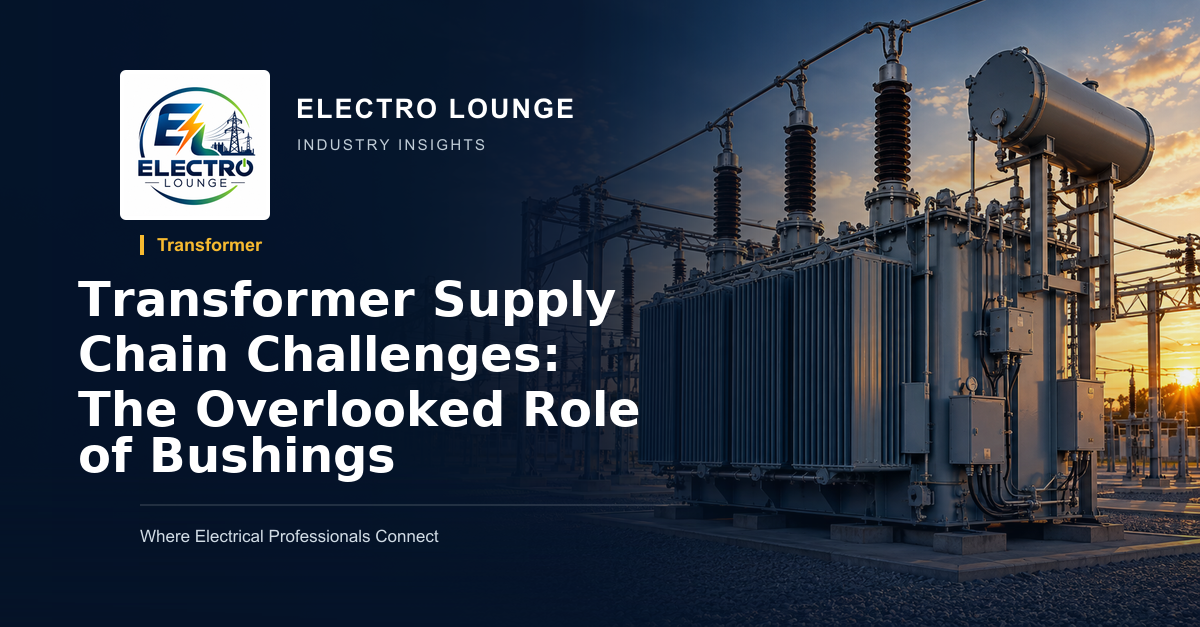
EXPLORE THE STORY · 4 MIN READ
Transformers are a cornerstone of electrical transmission and distribution systems worldwide, but their supply chains face significant complexity. While attention routinely falls on high-profile components such as turbines, copper windings, and steel structures, one critical element often escapes scrutiny: the transformer bushing.
What Are Transformer Bushings?
A transformer bushing enables electrical conductors to pass safely through an earthed transformer tank, providing air-tight insulation between live conductors and grounded surfaces. Each transformer typically carries between five to seven bushings. Unlike some parts, bushings have no practical substitute. Their role is non-negotiable: if a required bushing is missing, the transformer cannot be shipped or commissioned.
Why Bushings Matter in the Supply Chain
Recent updates attributed to GE Vernova — substation highlight a pressing issue: while industry observers may track turbines, copper, and steel supplies as indicators of transformer production health, they too often overlook bushings. Yet, this overlooked component can determine whether a transformer reaches its destination or remains in the warehouse.
Impacts on Project Timelines and Grid Expansion
The implications for electrical professionals are serious. Extended transformer lead times, now reportedly reaching four years, can often trace their roots as much to auxiliary component shortages like bushings as to prime materials. A single missing bushing means an entire transformer, potentially holding up major grid upgrades or new substation deployments, sits idle.
For power system engineers, planners, and procurement teams, this highlights the interconnectedness of transformer supply chains. Even if major raw materials are available, successful project delivery still hinges on the availability of every essential auxiliary component—including bushings, for which there are no direct alternatives.
Beyond Material Sourcing: The Need for Holistic Planning
This situation underscores a broader challenge in transformer procurement and project management. As lead times approach or exceed four years, stakeholders need robust forecasting, supplier risk assessments, and comprehensive supply chain visibility—not only for primary materials but also for specialized components like bushings.
Supply Chain Management Best Practices
To address these supply chain bottlenecks, electrical professionals may consider diverse sourcing strategies, earlier procurement of long-lead items, and enhanced supplier partnerships. Although these steps cannot eliminate all the risks, monitoring the full bill of materials for transformers is now essential practice.
Looking Ahead
The power sector’s transition and expansion require not just grand investments in large hardware, but also diligent attention to every component that enables reliable, on-time deployment. Focusing on bushings as a potential supply chain bottleneck reminds us that resilient infrastructure depends on managing both the big and small parts of the process.
Attribution: GE Vernova — substation, published 2026-10-22.
🇺🇸
THE ENGINEERING CORNER
MVA is a capacity clue—not a promise at the socket
A transformer’s megavolt-ampere (MVA) rating describes apparent power. Megawatts (MW) describe active power. They are related through power factor; the two numbers should not be swapped without stating that assumption.
Try a simple example: an illustrative 100 MVA load operating at 0.90 power factor corresponds to 90 MW. That calculation describes the assumed operating point, not a guaranteed continuous output, a utility’s available generation or a measured project result.
Ask what constrains the complete path: the incoming network, transformer, busbars, outgoing circuits or downstream demand. Adding nameplate capacities across several substations also does not establish how much can reach one particular load. Network arrangement, equipment limits and operating conditions still matter.
The useful habit is to separate three statements: what equipment is rated to carry, what the network can transfer under the studied conditions, and what customers actually receive. An equipment announcement normally establishes only part of that picture.
THE ENGINEERING CORNER
Follow the whole power path
Think of a substation project as one part of a connected power path. There is a supply side, the equipment being discussed, and a demand side. Each part has its own capabilities, constraints and operating conditions.
A headline about new capacity is therefore a useful starting question: where was the original bottleneck, and which part of it does this project address? More installed equipment does not, by itself, quantify customer reliability, actual energy delivered or the capacity available during an outage.
Planning language matters too. A preferred site, a contract award, equipment delivery, installation and commissioning are different milestones. Do not read an announced plan as an asset already operating. The source should support the particular stage being described.
To make the story useful, sketch a simple supply-to-load chain and place the named asset on it. Mark what the report establishes and leave unknown interfaces as questions. That small exercise helps a fresh engineer connect project news with system thinking without inventing voltage levels, settings, test results or customer benefits that the announcement does not provide.