WHERE ELECTRICAL PROFESSIONALS CONNECT

A little spark. A shared passion.

Prepare for the power transmission industry. Build your understanding of substations, protection, testing and commissioning — then connect with people who share your passion.

News from Electro Lounge A forum for our members
⚡ Ready for your next spark? Test Your Knowledge →

Category Technical Articles

Understanding Surge Protection Devices (SPD): Types, Mechanisms and Key Characteristics
Understanding Surge Protection Devices (SPD): Types, Mechanisms and Key Characteristics

A Surge Protection Device (SPD) is a component of the electrical installation protection system. SPDs are used for electric power supply networks, telephone networks, and communication and automatic control buses. They are connected in parallel on the power supply circuit…
Design Rules for Electrical Installation Protection Systems

Design Rules for Electrical Installation Protection Systems

Protection systems in building electrical installations rely on key rules for selecting Surge Protective Devices (SPDs) and their supporting components. SPDs are chosen based on their type, the quantity needed, and how much lightning they must withstand, which is expressed…

Understanding General Rules of Lightning Protection in Buildings

Understanding General Rules of Lightning Protection in Buildings

Lightning protection aims to guard both building structures and electrical installations from the risks posed by lightning strikes. Protection systems are designed with key mechanisms: firstly, by capturing lightning current and directing it to earth through the most direct path,…

Selectivity and Cascading: Two Different Protection Design Questions

Selectivity and Cascading: Two Different Protection Design Questions

Protection system design for substations involves precise coordination strategies. Two key concepts—selectivity and cascading—often arise together but address distinct aspects of circuit protection. Selectivity refers to the practice of ensuring only the most appropriate protective device operates when a fault…

Understanding Power Factor: The Difference Between kW and kVA in Substation Loading Records

Understanding Power Factor: The Difference Between kW and kVA in Substation Loading Records

As a new substation engineer, understanding the distinction between active power (kW) and apparent power (kVA) is crucial for interpreting transformer loading records. Active power (kW) reflects the energy converted into useful mechanical work, heat, or light, while apparent power…

Circuit breaker resistance and timing: different evidence

Circuit breaker resistance and timing: different evidence

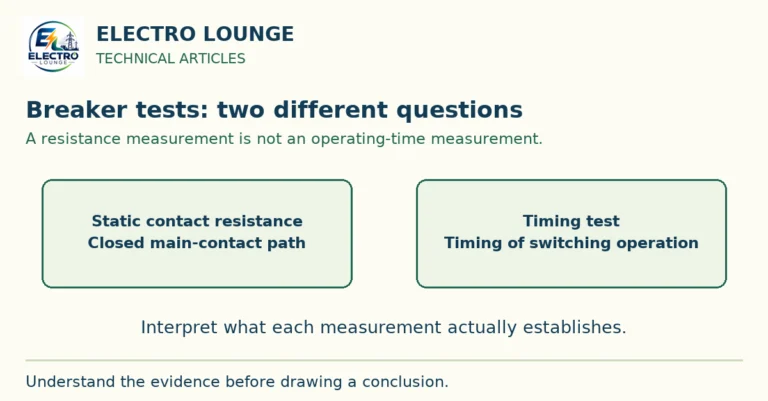
Why read this? Different breaker measurements answer different questions. Static contact resistance examines the closed main-contact current path. A timing test examines the timing of the switching operation. Coil-current, motor-current and motion measurements provide other forms of assessment. Illustrative comparison:…