EXPLORE THE STORY · 5 MIN READ
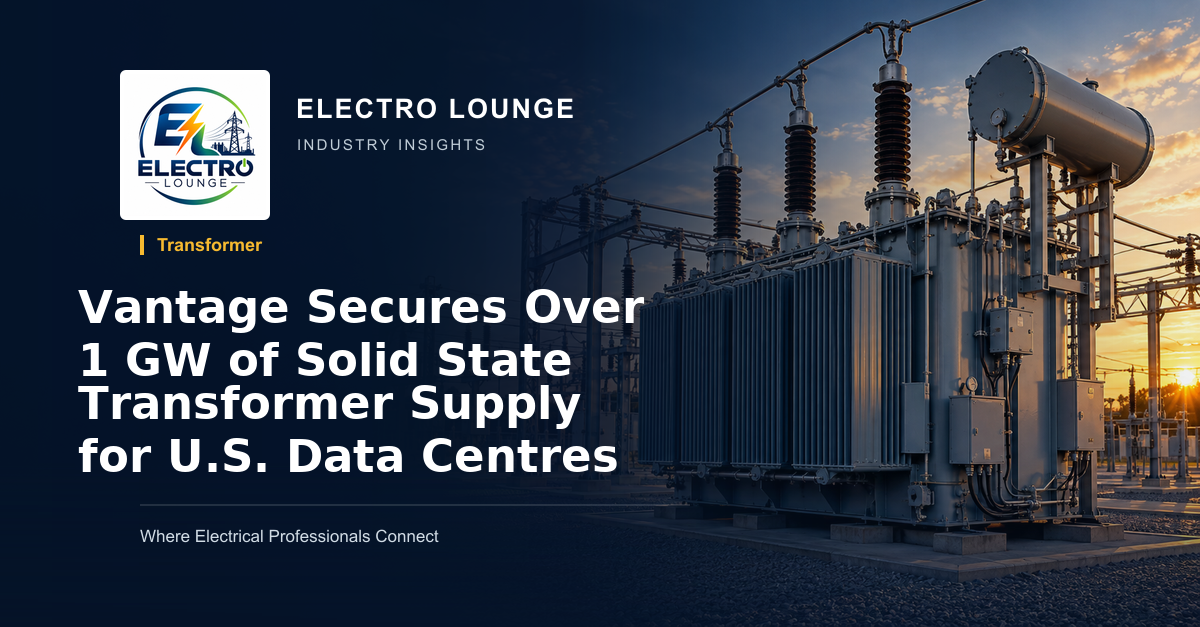
A major development in the U.S. data centre sector has taken place, as Vantage has secured over 1 gigawatt (GW) of solid state transformer (SST) supply from Heron Power. These modular converters are set to support 800-volt direct current (DC) rack deployment across Vantage’s portfolio of hyperscale data centres.
Background and Organizations Involved
Vantage is a well-known operator of hyperscale data centres in the United States. Heron Power specializes in manufacturing advanced solid state transformers. The partnership between these two organizations reflects a significant step forward for U.S. infrastructure, particularly as power systems demand smarter, more efficient solutions to handle the ever-increasing needs of data centres.
What Are Solid State Transformers?
Solid state transformers (SSTs) are advanced power converters that use semiconductor components instead of the traditional copper and iron found in conventional transformers. This new technology allows for greater efficiency, compact size, and improved control over electricity flow. Modular SSTs make it easier to scale data centre power, manage loads, and enable the transition to higher DC voltages, which can benefit both operational flexibility and energy savings.
Key Technical Details
The confirmed supply involves over 1 GW of capacity and is designed for the deployment of 800 V DC racks. A direct current rack at 800 volts allows for higher efficiency and reduced energy losses compared to lower-voltage systems. This voltage level supports the needs of large-scale digital infrastructures that require reliable, high-capacity, and energy-efficient power delivery.
Why This Matters to Electrical Professionals
For electrical engineers and professionals, this announcement has several points of significance:
– Large-scale SST adoption: An order of over 1 GW shows accelerating industry acceptance of solid state transformers in critical infrastructure settings.
– Support for higher-voltage DC: The move to 800 V DC rack systems is gaining traction in the data centre sector, potentially offering reduced conversion losses and improved equipment performance.
– Modular converter technology: Modular SSTs can offer scalability and simplified maintenance—a trend worth watching as more facilities pursue digital expansion.
Broader Industry Impact
Data centres are among the fastest-growing segments driving demand for advanced power infrastructure. The commitment to 800 V DC racks and modular SSTs indicates a broader trend where leading operators invest in both efficiency and future scalability. For electrical professionals, learning about these technologies and their integration into real-world projects can be valuable for staying up to date with industry best practices and next-generation equipment.
Project Status and Next Steps
According to the latest developments, Heron Power’s modular converters are being prepared for deployment across Vantage’s facilities. This supply supports Vantage’s strategy of advancing power systems in its hyperscale data centres, located throughout the United States. Specific project timelines, funding details, and technical performance results were not disclosed in the source material.
Takeaway
This development marks an important step in how advanced power electronics are being integrated into mission-critical environments for improved efficiency and scalability. For those involved in power systems design, manufacturing, or project management, this partnership underscores the importance of staying current with SST technology and the shift towards high-voltage DC distribution in the data centre industry.⚡🏢
#ElectroLounge #PowerSystems #ElectricalEngineering #UnitedStates #Vantage #HeronPower
THE ENGINEERING CORNER
MVA is a capacity clue—not a promise at the socket
A transformer’s megavolt-ampere (MVA) rating describes apparent power. Megawatts (MW) describe active power. They are related through power factor; the two numbers should not be swapped without stating that assumption.
Try a simple example: an illustrative 100 MVA load operating at 0.90 power factor corresponds to 90 MW. That calculation describes the assumed operating point, not a guaranteed continuous output, a utility’s available generation or a measured project result.
Ask what constrains the complete path: the incoming network, transformer, busbars, outgoing circuits or downstream demand. Adding nameplate capacities across several substations also does not establish how much can reach one particular load. Network arrangement, equipment limits and operating conditions still matter.
The useful habit is to separate three statements: what equipment is rated to carry, what the network can transfer under the studied conditions, and what customers actually receive. An equipment announcement normally establishes only part of that picture.
THE ENGINEERING CORNER
Follow the whole power path
Think of a substation project as one part of a connected power path. There is a supply side, the equipment being discussed, and a demand side. Each part has its own capabilities, constraints and operating conditions.
A headline about new capacity is therefore a useful starting question: where was the original bottleneck, and which part of it does this project address? More installed equipment does not, by itself, quantify customer reliability, actual energy delivered or the capacity available during an outage.
Planning language matters too. A preferred site, a contract award, equipment delivery, installation and commissioning are different milestones. Do not read an announced plan as an asset already operating. The source should support the particular stage being described.
To make the story useful, sketch a simple supply-to-load chain and place the named asset on it. Mark what the report establishes and leave unknown interfaces as questions. That small exercise helps a fresh engineer connect project news with system thinking without inventing voltage levels, settings, test results or customer benefits that the announcement does not provide.