EXPLORE THE STORY · 4 MIN READ
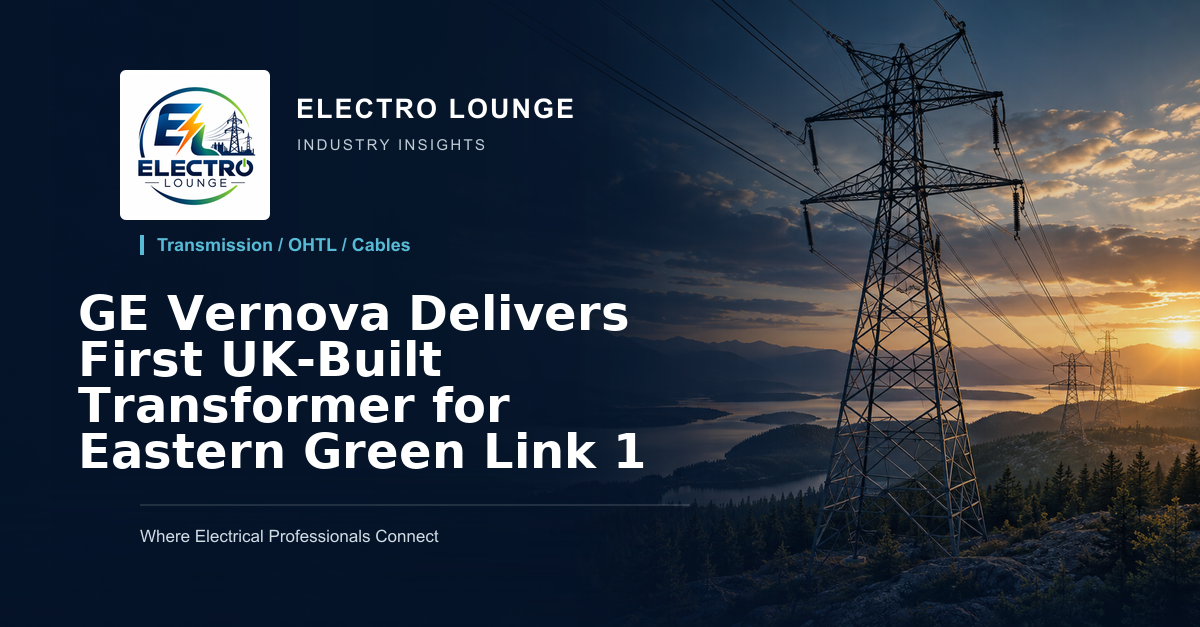
GE Vernova, a global energy technology company, has completed the first in a series of 14 high-voltage transformers for the Eastern Green Link 1 (EGL1) subsea transmission project in the United Kingdom. This significant engineering milestone marks the start of equipment deliveries that will enable one of the country’s largest electrical interconnections to move closer to operation.
The transformer, built in the United Kingdom, is now ready for transport. According to the project timeline, installation at EGL1’s converter stations will begin in July 2027. This delivery is especially notable because it is the first transformer produced domestically for this particular project.
Eastern Green Link 1 is a large-scale subsea transmission initiative designed to carry up to 2 gigawatts (GW) of electricity between converter stations. Subsea transmission systems like EGL1 are crucial for transferring large amounts of electrical power over long distances, particularly in regions where renewable energy is abundant and must be moved to centers of demand. In this context, a converter station is an installation that converts electricity between alternating current (AC) and direct current (DC), enabling efficient long-distance transport.
Transformers are a fundamental component of such infrastructure. They are used to step up (increase) or step down (decrease) voltage levels so that electricity can be transmitted efficiently and safely. For an interconnector like EGL1, large-scale transformers ensure the reliable and effective integration of high-capacity transmission links into the existing grid.
The completion of the first transformer is just the beginning for EGL1. In total, 14 UK-built transformers are planned for deployment across the converter stations of this project. On-site installation is scheduled to commence in mid-2027, reinforcing the timeline for this major infrastructure development. This aligns with wider efforts in the UK to support grid upgrades, the shifting energy landscape, and the continuing integration of renewable power sources.
For engineers and professionals in the power sector, this development highlights several key points:
• The importance of domestic manufacturing capacity for critical grid components.
• The scale and complexity involved in coordinating multi-year subsea transmission projects.
• The essential role of transformers in ensuring the security and efficiency of high-voltage, long-distance power transmission.
This stage also provides a reference for project tracking and future tendering activities associated with UK grid enhancements. As technologies evolve and demand patterns change, large projects like EGL1 provide crucial lessons for equipment specification, logistics coordination, and regulatory compliance.
Professionals involved with major transmission links, grid integration, or renewable energy delivery should monitor developments at EGL1 and similar interconnector initiatives. These projects represent both engineering challenges and opportunities to support the sustainable modernization of national power infrastructure.
For further project specifics and technical coverage, refer to Transformer Magazine.
🇬🇧🚢🔌
THE ENGINEERING CORNER
MVA is a capacity clue—not a promise at the socket
A transformer’s megavolt-ampere (MVA) rating describes apparent power. Megawatts (MW) describe active power. They are related through power factor; the two numbers should not be swapped without stating that assumption.
Try a simple example: an illustrative 100 MVA load operating at 0.90 power factor corresponds to 90 MW. That calculation describes the assumed operating point, not a guaranteed continuous output, a utility’s available generation or a measured project result.
Ask what constrains the complete path: the incoming network, transformer, busbars, outgoing circuits or downstream demand. Adding nameplate capacities across several substations also does not establish how much can reach one particular load. Network arrangement, equipment limits and operating conditions still matter.
The useful habit is to separate three statements: what equipment is rated to carry, what the network can transfer under the studied conditions, and what customers actually receive. An equipment announcement normally establishes only part of that picture.
THE ENGINEERING CORNER
Follow the whole power path
Think of a substation project as one part of a connected power path. There is a supply side, the equipment being discussed, and a demand side. Each part has its own capabilities, constraints and operating conditions.
A headline about new capacity is therefore a useful starting question: where was the original bottleneck, and which part of it does this project address? More installed equipment does not, by itself, quantify customer reliability, actual energy delivered or the capacity available during an outage.
Planning language matters too. A preferred site, a contract award, equipment delivery, installation and commissioning are different milestones. Do not read an announced plan as an asset already operating. The source should support the particular stage being described.
To make the story useful, sketch a simple supply-to-load chain and place the named asset on it. Mark what the report establishes and leave unknown interfaces as questions. That small exercise helps a fresh engineer connect project news with system thinking without inventing voltage levels, settings, test results or customer benefits that the announcement does not provide.