

EXPLORE THE STORY · 4 MIN READ
A test number can look precise and still be misunderstood. The first question is whether it has been compared with the right expectation.
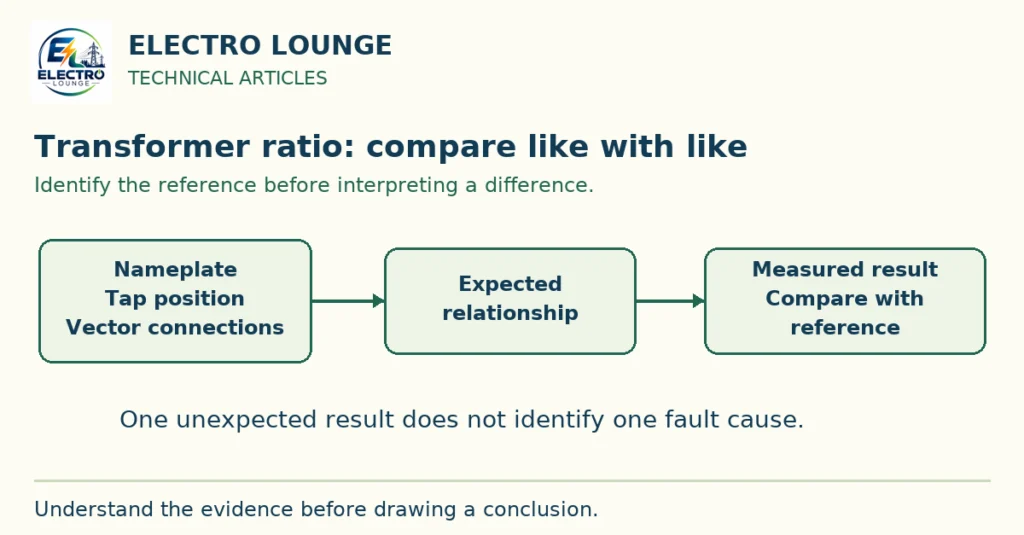
A turns ratio test checks voltage conversion against design and nameplate information. The selected tap and winding vector connections matter when interpreting the comparison.
Illustrative comparison: readings for different tap positions should not automatically be treated as equivalent tests. Identify the expected relationship for the applicable configuration.
An unexpected ratio can be associated with winding, tap-changer, connection or nameplate problems. It does not establish one cause by itself. Winding-resistance and excitation-current results can provide additional evidence.
The practical lesson is to match the result to its reference before drawing a conclusion. Ratio testing alone cannot diagnose every transformer problem.
THE ENGINEERING CORNER
A ratio result needs the right comparison
A transformer ratio test compares applied and measured quantities under a defined test arrangement. Before interpreting the result, establish the winding connection, terminal identification and tap position from the transformer’s approved documentation.
For three-phase equipment, a phase-voltage relationship and a line-voltage relationship are not interchangeable without accounting for winding connections. A mismatch between the test configuration and the expected relationship can create an apparent discrepancy that is not evidence of the fault being suggested.
Build the explanation in order: state what was connected, identify the expected relationship, record the tap position, and then explain the comparison. Keep the observed result separate from the conclusion. If the supporting information is missing, the conclusion remains limited.
Ratio testing is one part of a wider assessment. Other tests investigate other aspects of a transformer. A satisfactory ratio result alone does not certify insulation condition, thermal performance, every winding connection or readiness for service. Acceptance decisions require the full approved scope and competent review.
THE ENGINEERING CORNER
MVA is a capacity clue—not a promise at the socket
A transformer’s megavolt-ampere (MVA) rating describes apparent power. Megawatts (MW) describe active power. They are related through power factor; the two numbers should not be swapped without stating that assumption.
Try a simple example: an illustrative 100 MVA load operating at 0.90 power factor corresponds to 90 MW. That calculation describes the assumed operating point, not a guaranteed continuous output, a utility’s available generation or a measured project result.
Ask what constrains the complete path: the incoming network, transformer, busbars, outgoing circuits or downstream demand. Adding nameplate capacities across several substations also does not establish how much can reach one particular load. Network arrangement, equipment limits and operating conditions still matter.
The useful habit is to separate three statements: what equipment is rated to carry, what the network can transfer under the studied conditions, and what customers actually receive. An equipment announcement normally establishes only part of that picture.
THE ENGINEERING CORNER
Follow the whole power path
Think of a substation project as one part of a connected power path. There is a supply side, the equipment being discussed, and a demand side. Each part has its own capabilities, constraints and operating conditions.
A headline about new capacity is therefore a useful starting question: where was the original bottleneck, and which part of it does this project address? More installed equipment does not, by itself, quantify customer reliability, actual energy delivered or the capacity available during an outage.
Planning language matters too. A preferred site, a contract award, equipment delivery, installation and commissioning are different milestones. Do not read an announced plan as an asset already operating. The source should support the particular stage being described.
To make the story useful, sketch a simple supply-to-load chain and place the named asset on it. Mark what the report establishes and leave unknown interfaces as questions. That small exercise helps a fresh engineer connect project news with system thinking without inventing voltage levels, settings, test results or customer benefits that the announcement does not provide.